Z-accuracy for D455
For D455, the Z-accuracy is smaller than 2%. (up to 4 meters)
I was wondering what is the meaning of "smaller than 2%" for z-accuracy. Is that mean there are max. 2% differences between the measurement and true value?
In 4 meters range, is that mean there would be (4 meters) (2%) = 0.08 meters absolute error in max. ?
or, how to find out the z-accuracy in meters in different ranges?
Thanks
-
Hi Lamlk1341 <2% is a good general value for describing the accuracy of a RealSense 400 Series camera. There are a range of factors though, such as environment and lighting, that can affect accuracy.
Describing accuracy as the difference between the camera's measured distance value and the actual distance (e.g distance from the camera to a target that is measured with a ruler / tape measure) is a good way to interpret it.
With RealSense 400 Series cameras, error starts at near zero at the camera lenses and increases linearly over distance. This phenomenon is called RMS error and is described in point 5. Understand theoretical limit of the section of Intel's camera tuning guide linked to below.
The D455 model has 2x the accuracy over distance of the D435 / D435i models, meaning that at 6 meters distance the D455 can have the same accuracy that a D435 / D435i has at 3 meters (the point beyond which drift in accuracy becomes noticable on those models).
-
Thanks for your prompt reply! I understand the theoretical limit for depth cameras now.
Regarding D455, I found the baseline is 95mm and the HFOV is 87 degree according to the Page.55 in "Intel RealSense Camera D400 Series Product Family Datasheet". Are they correct?
Furthermore, what is Xres(pixels) in the formula for the focal length? and what is the value of Xres(pixels) for D455?
Lastly, it is mentioned that "a well-textured target you can expect to see Subpixel < 0.1 and even approaching 0.05. In general you should see ~30% smaller Subpixel with the laser turned off." What is the general subpixel value for a plane surface or a not well-textured target.
By the way, do you have a chart of Depth RMSE error for D455, like the chart for D415 and D435 in your link?
Thank you!
-
The FOV for the D455 in the data sheet matches with the depth FOV for that model in the RealSense Store specification listing and with Intel's camera model comparison chart at the link below.
https://www.intelrealsense.com/compare-depth-cameras/
The 95 mm baseline figure is verified in Intel's information page listing for the D455.
https://www.intelrealsense.com/depth-camera-d455/
In the formula for calculating focal length in pixels in the RMS error information that I linked to earlier, xres refers to the horizontal size of a particular resolution. The resolution is expressed as horizontal x vertical. For example, with resolution 1280x720 xres would be 1280, and with 848x480 xres would be 848.
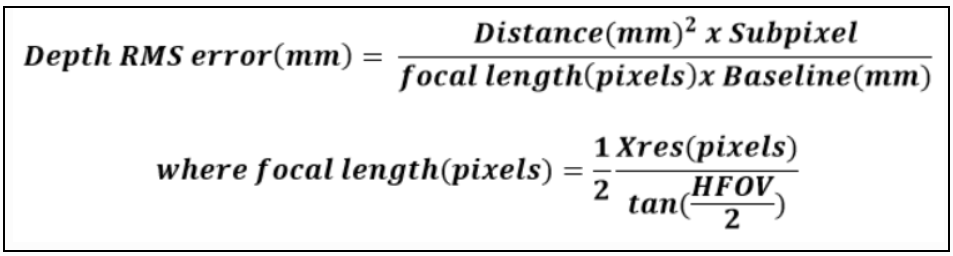
Intel also has a Subpixel Linearity white-paper document in the link below that features the above formula.
It is difficult to provide a subpixel value estimate for a low-textured target. The most logical conclusion would be that if 0.1 or less is considered good, a value above 0.1 would be not as good, and worsen as the value increases further above 0.1. Further advice on this subject is provided here:
https://github.com/IntelRealSense/librealsense/issues/3904
A chart for D455 that is equivalent to the D415 / D435 RMS curve does not exist. A chart can be plotted using the formula. In general though, the D455 has 2x the accuracy over distance of the D435. At 6 meters distance, the D455 therefore has the same accuracy that the D435 has at 3 meters.
Since the D415 has around 2x less error over distance than the D435 though (shown by its flatter curve) then you could simply assume that the D455 curve might be similar to the D415 one.
-
The D455's optimal depth accuracy resolution is 848x480, so I would recommend using that. If you would prefer 1280x720 though then you could try using it in combination with the High Accuracy camera configuration preset to help to filter out inaccurate depth points.
If you find that the High Accuracy preset filters out too much of the depth information then Medium Density provides a good balance between accuracy and the amount of depth detail ('fill rate').
-
Preset files are used by applications created in the RealSense SDK. Dot3D Pro is a software application that is compatible with RealSense camera hardware, not a RealSense SDK application.
The company DotProduct should be contacted with questions about Dot3D, as they are its publisher.
-
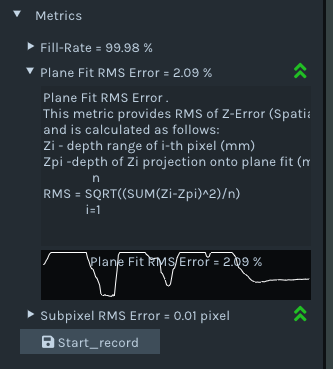
I tested a D415 with the SDK's Depth Quality Tool which can provide a subpixel linearity value in the Metrics category of its options side-panel. When initially following the tool's instructions to turn the camera's orientation to calibrate it to a wall, subpixel linearity was initially set at a default of '0'. After completing the set of requested orientations, on average I could achieve a result of around 0.01 (which would be considered very good) but the absolute minimum that the tool would allow subpixel linearity to be was always '0'.
As far as I am aware, there is not a defined maximum for the value.
-
Hello, i just bought a D455 for a unity project but i am only using it at small distances (0,5 - 2 meters).
And i have seen that the "ideal range" in the documentation is 6m for the D455 and 3 meters for the previous models and their minimum depth distance is 0,28 compare to the 0,52 cm of the D455.
Since i'm using it only in these small distance isnt better for me to take one of the previous model ? (Not talking about the price but the technologie) -
Hi Youcefbouzgaou With the 400 Series camera models, the amount of error starts at around zero at the camera lenses and increases linearly as the distance from the camera of an observed object / surface increases. This phenomenon is called RMS error.
The D455 has 2x the accuracy over distance of the D435 and D435i models. So at 6 meters range, the D455 has the same accuracy as the D435 / D435i has at 3 meters.
The D455 has a default minimum depth sensing distance of 0.4 meters (compared to 0.1 m on D435 / D435i, enabling those models to get closer to an object / surface). If you are using the D455 at 0.5 m distance minimum though then there would be no advantage to switching to a D435 / D435i and your D455 will have some additional advantages over those models. This includes the previously mentioned greater accuracy over distance, improved depth-color alignment and a faster shutter on the RGB sensor to aid in capturing fast motion without blurring.
Please sign in to leave a comment.
Comments
11 comments