D400 Calibration for custom housing
Hi everyone,
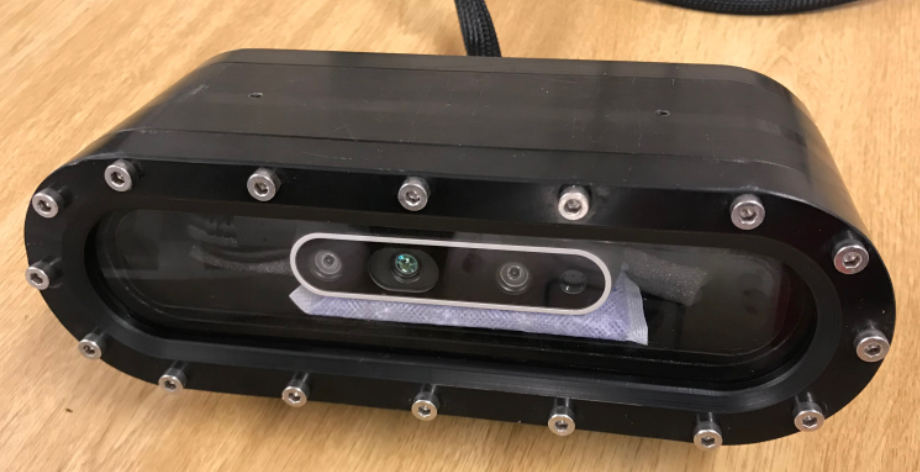
The project I'm working on requires a custom housing. We have two options, either we build a new housing around the existing one, or we build this housing around the PCB "bare" version of the cameras.
In both cases we have a question : what do we need to take into account the housing ?
Is it sufficient to recalibrate using OEM calibration target ?
Is it okay to add an extra "glass window" in front of the built-in one ?
Thanks for your help !
-
Hi Thomas Specte It is fine to place a custom housing with a transparent window around a cased RealSense camera that already has front glass. At the link below, a RealSense team member provides advice that is relevant to designing a housing for both a cased camera and a Depth Module PCB version.
https://github.com/IntelRealSense/librealsense/issues/2566#issuecomment-431852571
If your project will involve the camera being located underwater in a custom housing behind a window then the link below has an extensive technical discussion about calibrating the camera for that environment.
https://github.com/IntelRealSense/realsense-ros/issues/1723
In regard to an OEM calibration target, for the underwater environment the use of the $1500 USD OEM Calibration Target system was recommended. I would recommend checking first whether the free public version of the Dynamic Calibration software tool can meet your needs though. The free version only calibrates extrinsics whilst the OEM Dynamic Calibration tool calibrates both intrinsics and extrinsics. The non-OEM version of the software is fine for the needs of most RealSense users though, as the OEM calibration target system is targeted at engineering departments and manufacturing facilities.
Page 151 of the current edition of the data sheet document for the 400 Series cameras provides further technical recommendations for a custom "cover material" for the sensors of a Depth Module.
https://dev.intelrealsense.com/docs/intel-realsense-d400-series-product-family-datasheet
-
Sorry, maybe one quick question before we close this thread :
- page 151 you make recommendations about the cover material : can I assume it is the same recommandations with or without the existing casing ?
- In the same table there is the entry : "Thickness of cover" = 0.55m +/- 0.03mm. Is it a recommendation or is it the actual thickness of the window built-in the casing ?
- In conclusion : can I add a cover of 0.55mm in front of the existing window glass, recalibrate (either with the free version or the OEM tool) and get the same data quality as before ?
(sorry to ask again all these questions but I just want to be sure I got it right)
Thanks for your help !
-
The bottom of page 106 and top of page 107 of the data sheet have further guidance about cover material selection, citing uncoated clear acrylic (plexiglass) as an example of a cover material.
RealSense 400 Series cameras can have thin-film sheets of physical optical filter product placed over the front glass of a cased camera model, so adding an additional transparent window of similar thickness to 0.55 mm as an overlay on existing casing front-glass should be fine. Further details about using optical filters with 400 Series cameras can be found in Intel's optical filter white-paper guide at the link below.
https://dev.intelrealsense.com/docs/optical-filters-for-intel-realsense-depth-cameras-d400
Whilst there is not a reference available regarding a maximum thickness of an outer window in a custom housing that a camera is enclosed within, my opinion would be that so long as the outer window is non-reflective on both sides (such as using a non-reflective material or an anti-reflective coating) then the camera should be able to work with it regardless of thickness so long as light can pass through it with sufficient ease.
Page 107 of the data sheet states that "Intel RealSense Camera 400-Series provides control over laser power and sensor exposure. Minor loss of transmission due to cover material transmissivity might be compensated by increasing exposure when less light is able to reach the sensors and by increasing laser power for IR projector pattern projection loss".
Please sign in to leave a comment.
Comments
5 comments