Inquiry Regarding Depth Accuracy Interpretation and Model Recommendation for Rack Scanning
Dear Realsense Team
I am writing to inquire about the specifications of the Intel RealSense D400 series on behalf of our customer.
1. Interpretation of Depth Accuracy
The datasheet for the D400 series states that the depth accuracy is "< 2% at 2m".
Could you please clarify how this percentage should be interpreted in terms of millimeters? Does it imply an error margin of up to ±40mm at a 2m distance, or is there a more specific way to calculate the expected error range (e.g., Z-accuracy formula)?
2. Model Recommendation
Our customer has the following specific requirements:
-
Application: Scanning a rack.
-
Scan Range: Up to 3 meters.
-
Required Accuracy: Approximately 3mm.
Given these constraints, is there a specific model within the RealSense lineup that can achieve ~3mm accuracy at a 3-meter distance? If the D400 series cannot meet this strict accuracy requirement at that range, please advise on the best available option or alternative solution.
I look forward to your technical advice.
-
Hello, thanks very much for your questions!
1. The easiest way to estimate depth error in millimeters is to use the RMS error formula in section 5 at the link below, as you suggested.
You may not need to actually plot the graph yourself to get a good estimate of how millimeter error increases as distance from the camera increases if you use the graph in this section.
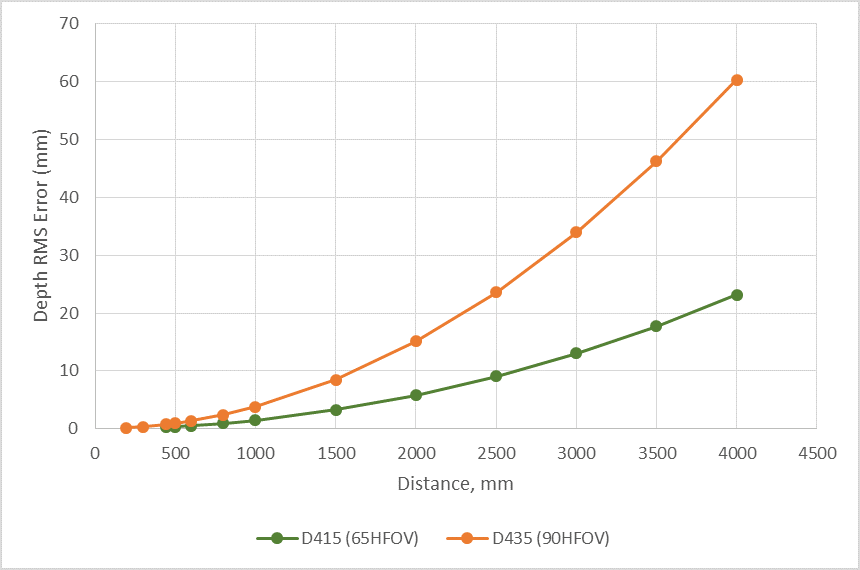
The above diagram demonstrates that the D415 camera model has 2x the accuracy / 2x less error over distance than the D435 type models.
The D455 type cameras have 2x the accuracy over distance of the D435 type cameras. So for a D455 or D456, the green curve of the D415 should also be representative of the accuracy over distance of D455 type models compared to the D435 type.
In your particular application, the D415 may give best results if the racks are not in motion, as this camera model is best suited to depth-sensing static objects whilst the other models are best suited to fast motion (movement of the camera or observing fast motion).
D415 has a smaller horizontal field of view though than the D455 type cameras, so if a wide rack has to be captured entirely in the camera's view without moving the camera then a D455 type camera will be better suited.
However, the RMS error graph suggests that at 3 meters distance the error may be up to 12 mm, with 3 mm being attainable at around 1 meter distance.
The real-world scene may be more easily depth-readable by the camera if an external dot pattern projector was added to project additional invisible dots onto the scene, as the denser the pattern of dots cast on the scene, the better as the camera uses the dots as a texture source for depth analysis. There is a guide at the link below about using projectors with 400 Series cameras.
Please sign in to leave a comment.
Comments
1 comment