Module D430 without RGB sensor
The tech specification of the D430 is not so clear regarding RGB sensor. Therefore my questions:
Does the D430 have a seperate RGB sensor? Same as the D435F?
Background of request:
We achieve best results with the D435F.
- The IR filter makes the camera more immune to our robot LED spotlights (blinking)
- Our customers operate the robot often in darkness (during night)
- We have to be able to read a 2D code. Plan is to do it with the RGB sensor. Illumination is done by the robot LED spotlights.
- We need to have a better IP proection than the D435F provides
-
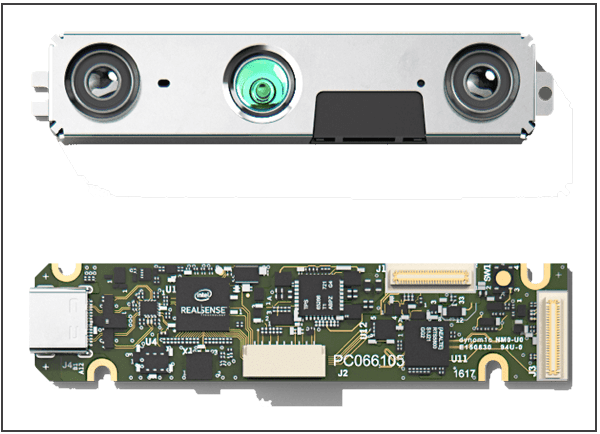
Hi Roman Leuzinger The D430 is a caseless Depth Module that is not equipped with an RGB sensor. When the D430 is used in the cased RealSense D435 and D435i models, the RGB sensor is connected separately via a cable.
A D430 Depth Module must be combined with a Vision Processor D4 Board and an interposer to connect the two together, which can be a flexible custom-made cable or a rigid circuit board that can be purchased pre-made.
You could explore the possibility of using a Chameleon XS commercial enclosure product for RealSense D415, D435 and D455 USB cameras that has IP66 and IP67 protection. It may be possible to place the D435 version of the housing around a D435f as the two models have almost the same physical measurements (90 mm × 25.8 mm × 25 mm for D435f, and 90 mm × 25 mm × 25 mm for D435).
https://www.autovimation.com/en/enclosures-en/chameleon-xs-realsense-en
-
In regard to modules with an RGB sensor, the D415 model of Depth Module has an integrated RGB sensor on its PCB.
The D401 Depth Module has RGB without an RGB sensor, as it can output high quality RGB from its depth sensor without needing a separate RGB component, though D401 is designed for short range (ideal depth sensing range 7 cm to 50 cm).
-
Thanks for the feedback.
Unfortunatelly the proposed case from Autovimation is too big for our application. Otherwise it would be the ideal solution. Probably we do have not other joice as to build our own casing. Either integrating the D435F completely or just its modules.
Do you sell as well the RGB sensor standalone?
Does the D4 Board integrate an interface including connector towards an external RGB sensor?
-
In fact RGB is not really required. What we need is an additional camera.
The setup which I think about is:
- Covering the 2 stereo cameras with IR filter
- Having a 3rd camera without IR filter. This camera is only used to read a 2D code (black/white) which is illuminated by robot LED spotlights
Backup would be:
Using D430 with IR filter. Implementing an external IR illumination which is just activated when we want to read the 2D code. Reading than the 2D code with one of the stereo cameras.
-
The RGB sensor is not sold standalone, though it is my understanding from previous discussions on the subject that sensor modules that meet the MIPI CS-2 interface format should be compatible.
Regarding connecting an RGB sensor to the D4 Board, the link below should be a useful reference.
https://github.com/IntelRealSense/librealsense/issues/1362
The D435f's CLAREX NIR-75N filter is available for purchase separately, opening the possibility of fitting it over the sensors of another RealSense cased camera or caseless Depth Module. More information can be found here:
-
Could you give me some more information about the mentioned interposer which can be a rigid circuit board that can be purchased pre-made?
- Manufacturer
- Produt name and number
It would be interesseting if there exist as well a buyable flex cable fitting the needs to contact the two boards. If that should not fit in our design, we still can make one specific to our needs. -
A custom flex interposer cable can be ordered from the company listed below, which is the officially listed supplier in the RealSense 400 Series data sheet document.
Cocom Consumer Electronics Ltd
Name: Janine Langdale
Office phone: +44 (0) 1444 461620
Mobile phone: +44 (0) 7905 692131 -
The rigid interposer PCB board can be purchased from component suppliers such as FRAMOS, Mouser and Rutronik24.
https://www.framos.com/en/products/d400-rigid-50-pin-interposer-20737
https://eu.mouser.com/ProductDetail/Intel/82635DSITR50P?qs=wd5RIQLrsJhIJqpBcxiaKQ%3D%3D
https://www.rutronik24.com/product/intel/82635dsitr50p/9745177.html
Manufacturer: Intel
Product Name: Intel RealSense D400 Rigid 50 Pin Interposer
Manufacturer part number: 82635DSITR50P
-
Are you referring to the interposer in the image below, please? If so then this flex inteposer is a flexible cable instead of a rigid square circuit board, which is useful for integration into product casings where using a rigid board to connect the D4 and the Depth Module would not be possible due to the internal dimensions of a casing and the other components within it.
This interposer cable can be ordered from Cocom Consumer Electronics at the contact details provided earlier in this discussion, or you can construct your own using the pin-out and 50-pin connector receptacle details in the data sheet.
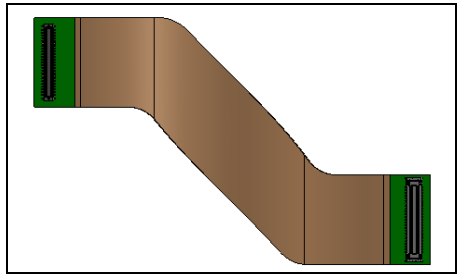
In addition, FRAMOS stock pre-made flexible 400 Series interposer cables under the HSF component name in a range of cable sizes referring to their length in mm (HSF50, HSF100, HSF150, HSF200).
https://www.framos.com/en/product-catalog/3d/3d-accessories
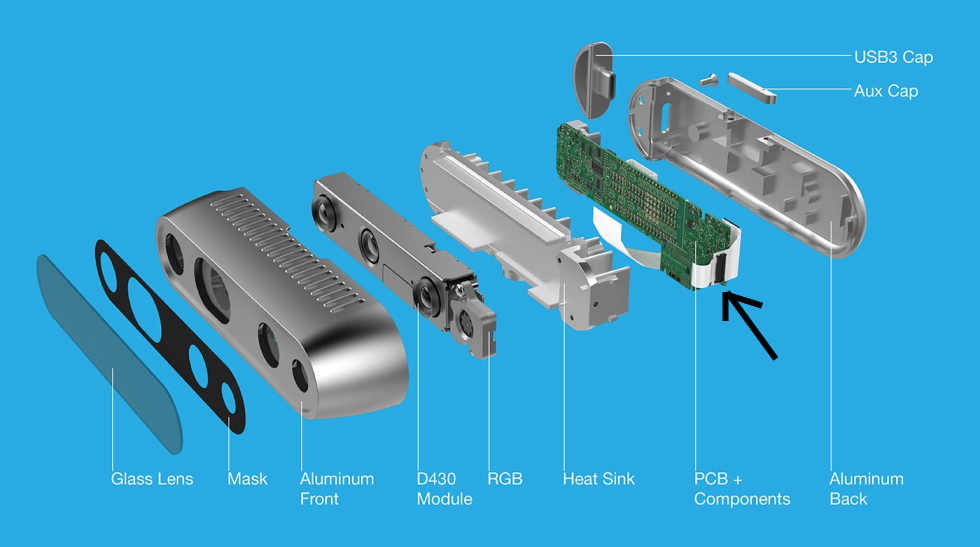
D435 uses a flexible interposer, as shown in the image below.
-
We have opened a D435 to learn more about the integration and it really helped to see its parts.
I am already in contact with Cocom for the flex interposer. I will get all the details from there. Either we take one of the of the shelf products or we look for a custom made.
In the D435 we have found some other parts. Question is if the can buy those as well on the market, or if we have to produce them by ourself. It would be helpfull if we can buy those ase well (as they are injecting molding parts).
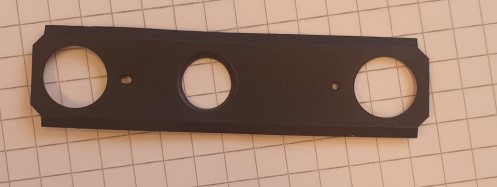
The mask on the D430 module.I guess its function is to reduce reflections between cover glass and metal case of the module.
Snapper on the D430 interposer. I guess its function is to secure the interposer connector from falling out.
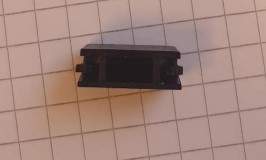
Are those parts availabe on the market?
-
The only parts that are available from retail are the camera Depth Module board, Vision Processor D4 board and interposer connector (flexible cable or rigid board). Customers who are integrating RealSense will need to provide their own equivalent of the other parts.
If you are planning to use a D430 and have access to a 3D printer or can find a company to print an object for you, the 3D printing blueprint at the link below may be helpful as a sensor mask. It was designed for use with the D435 camera model (which contains a D430 circuit board) and so the holes should align with the D430 sensors.
-
What kind of adhesive layer is used to stick the lens cover into the housing? Is this IP54?
Why is the NIR filter in front of the lens cover? Will there be problems if the NIR filter is mounted behind the lens cover?
Which adhesion layer is used to stick the NIR filter to the lens cover?
-
All of that information is related to the camera manufacturing process and so the details will not be available publicly, unfortunately. All technical information that is publicly shareable is in the data sheet document for the 400 Series cameras and system integrators will create their own solutions for aspects of the assembly that are not covered by the data sheet.
However, the data sheet recommends thermal double-sided adhesive for mounting the depth module and so such adhesive tape would be worth considering for attaching the lens cover to the housing and applying for the edges of the filter outside of the sensor hole.
-
Hi Roman Leuzinger, were you able to gather any information regarding the adhesive layer for mounting of the NIR filter on the cover window.
-
Thanks Roman Leuzinger for responding. By many options did you mean the adhesive tapes ?
Please sign in to leave a comment.
Comments
18 comments