Nuitrack Support for Raspberry Pi 3 and Tinkerboard Added
Hi everyone,
Nuitrack have expanded the supported platforms of their software to support Raspberry Pi 3 and Tinkerboard. The information released by Nuitrack is posted below:
**********************
We are glad to announce the new version of Nuitrack middleware!
The new version of Nuitrack 0.29.0 is released with the following improvements:
- Librealsense2 library version updated to v2.25.0
- Support for Raspberry Pi 3 and Tinkerboard devices
- Fixed crash when used in ROS
- Support for updating online licenses with connection through a proxy server
Coming soon:
- Nuitrack for iOS (Structure sensor)
- Nuitrack AI (new generation algorithm based on deep learning)
-
If you are using a Pi that is not Pi 4 and so have a USB 2.0 connection, Nuitrack has advice about what changes to do in order to use Nuitrack with RealSense and USB 2.0. I have pasted it below.
**************
You can connect RealSense via USB 2.0, but in this case you have to set lower resolution for a depth map. To do this, open nuitrack.config (%NUITRACK_HOME%/data), find the section "Realsense2Module" and add the following lines to "Realsense2Module.Depth":
"RawWidth": 640,
"RawHeight": 480, -
Another skeletal tracking solution for the RealSense D415, RealSense D435 and FRAMOS D435e cameras was highlighted by Intel during January's CES electronics show. It's called Cubemos, and will also work with the forthcoming new RealSense L515 lidar-based depth camera.
https://www.cubemos.com/skeleton-tracking-sdk/
Click on the 'Download SDK' button on the above link to go to a download page that has a link to the PDF user manual for Cubemos.
Here is a video of it running with the L515:
https://www.youtube.com/watch?v=PTMo4Dvya1Y&feature=emb_logo
-
I did further research on the subject of finding skeletal tracking solutions for RealSense cameras that might work with a Pi, but the possibilities seem to be slim. Intel did a seminar a while ago on advanced body tracking that is available on YouTube, though it typically requires multiple cameras to generate a data-set for the tracking before it can be used with a single camera.
-
You can get a basic distance measurement on a person using object recognition with a Deep Neural Network (DNN). It ought to be able to discern between two different people. I have seen DNN example programs that can detect more than one person separately. Here's an example of a program detecting the difference between an object and a human ("Person"):
https://github.com/twMr7/rscvdnn
Here is a multi-person example:
https://github.com/apoorvavinod/Real_time_Object_detection_and_tracking
-
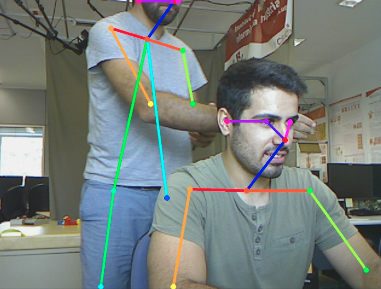
Another option for skeletal tracking you could investigate is OpenPose
https://github.com/stevenjj/openpose_ros
-
A more compact alternative to a NUC is the Intel Compute Stick pocket-sized PC.
https://www.intel.co.uk/content/www/uk/en/products/boards-kits/compute-stick.html
Please sign in to leave a comment.
Comments
15 comments