RGB Concern
Hi All,
I'm new to 3D camera / Skeletal Detection features please advice me on this topic. I look for the D400 series to use for skeletal detection and i know I need OpenCV to support the camera in order to use this feature but i concern on RGB frame rate 30 fps.
1. Do RGB really matter to be concern for depth / 3D camera / Skeletal Detection?
2. Do stereo camera related to skeletal detection? As i only know stereo camera use to stimulate the human binocular vision to recognize something in 3D image.
3. Do IR stereo needed for skeletal detection? As i know IR exist to support the camera by projecting speckle pattern to calculate the distance between object to camera using triangulation method.
4. Or does depth fps is the only matter i need to concern for skeletal detection?
Thank You
-
Whilst it is certainly possible to use OpenCV for skeletal detection, there is a commercial body tracking software called Nuitrack SDK that is compatible with the 400 Series cameras and makes skeletal tracking far easier. It is available for $39.99 a year and also has a free trial version.
I should make clear that my experience with skeletal tracking with RealSense 400 Series cameras is based solely on Unity and Nuitrack, so I cannot give a precise answer. When using skeletal tracking though with Nuitrack, it was not necessary to have RGB mode enabled. Nuitrack's beginner tutorial for the Unity engine does a good job of describing the process visually.
-
Thank a lot Marty, i have read the tutorial and i saw the software that contain different mode for skeletal tracking. is that mean i can use whichever mode that i think is suitable for my objective? And, also if i set only one skeleton count what will happen when there is two person in the camera fov?
Besides, we all knew that camera usually come with horizontal view is wider than vertical view but Nuitrack able to rotate it and use horizontal view as vertical view for skeletal tracking without rotate the camera?
lastly, if i'm doing kickbutt exercise or even more difficult posture will the camera able to detect?
-
If you are using Nuitrack, it can detect up to six individual skeletons. Nuitrack is very flexible, and you can enable only the modes you need. For example, in their Unity system you can set 'Skeleton' only if you want to just get skeleton data. If you want to overlay the skeleton joints on a live RGB image of the user(s) then you can additionally select the 'Color' mode.
Information on using Nuitrack for tracking at an angle other than horizontal straight-ahead is covered in this Nuitrack forum post:
https://community.nuitrack.com/t/i-need-a-wide-viewing-angle-vertically/497
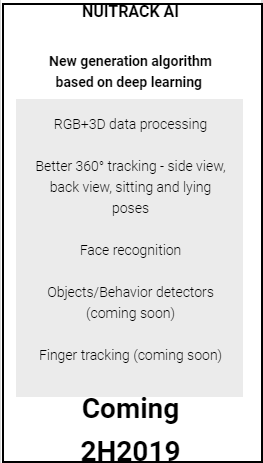
Nuitrack seems to be equal to the old Kinect cameras in terms of its full-body tracking. I understand that, like Kinect, it can have trouble with more unusual poses such as sitting and laying. Nuitrack are working on a more advanced version called Nuitrack AI that can cope with these positions though. It is due in the second half of 2019.
-
Hi Marty
Do Realsense D435 able to do measurement of the posture or this is depend on the SDK we use?My objective is use to calculate the angle of body posture during the exercise to ensure they are in right posture such as kickbutt, jumping jack, push-up and etc in Real-Time so put in simple this feature is operating during the user exercise in front of camera. It not mean by capture an image of user and calculate the measurement.
In the comment, Marty was mention to use Nuitrack SDK so if this is related to SDK should i bring this to Nuitrack?
Besides, I was found Openpose in youtube which certain people use for skeletal detection as well. Do Marty have any information to shared with me on this?
If you require any further information, let me know. I look forward to seeing you soon.
Thank You,
SincerelyJosh Khor
-
I am not familiar with OpenPose, unfortunately. As I mentioned earlier, OpenCV is certainly a way in which skeletal tracking can be done, though it requires more work than using a commercial solution such as Nuitrack.
A discussion on the Nuitrack forum about using Nuitrack for a fitness application (in the link below) may provide useful guidance for you.
https://community.nuitrack.com/t/fitness-application-development-initial-questions/817
The Nuitrack forum is certainly a good place to post a question to if you have a query about how a certain use of it might be able to be implemented.
In my own custom-written full-body system that I created, I assign a value of 0-1 to a particular body motion. For example, arm fully lowered would be '0' and arm fully raised as far as anatomically possible would be '1'. Waist fully upright would be '0' and waist bent over 90 degrees would be '1'. By comparing the values of each tracked body part in combinations, you can accurately predict what the body is doing at a given moment.
For example, if the legs were '1' (crouched), the waist was '1' (fully bent over) and the arms were '0.5' (lifted halfway to their full lift position, out in front of the body) then I might be able to automatically determine from this that the body was in a crouched on all-fours position.
Please sign in to leave a comment.
Comments
5 comments