Minimum and maximum power requirement for Intel Realsense D410
Hi,
We are using Intel realsense (D410) module in people count application. we are observing frequent frames missing and module disconnection. Please let us know what will the minimum and maximum power will be required for the sensor.
When we measured through power supply, sensor is used to take 5V at 330mA (1.65W)
Please let me know if required power is not supplied to sensor, whether frames missing and module disconnection will come
Regards
K Gururaja
-
Hi Gururaja K As you mention, the minimum power draw will be around 5 V.
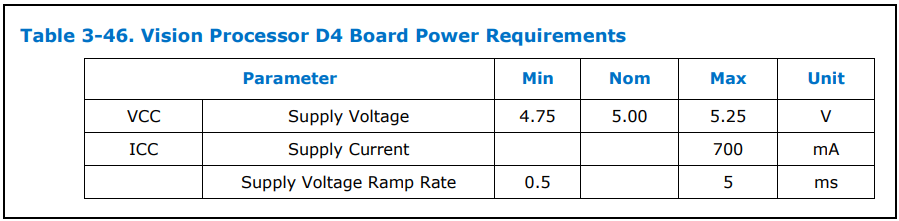
In regard to maximum power draw, it is recommendable to budget for 2W per camera.
Yes, disconnection is likely to occur if the camera's power needs are not met.
-
Hi,
Thanks for the valuable inputs.
We have observed that D410 Intel sensor is affected by temperature. some of scenario's
1. when the ambient temperature is 47 degree Centigrade, noticed on frames missing
2. when the ambient temperature is more then 50 degree centigrade, sensor is rebooting
3. when the ambient temperature is more than 55 degree centigrade, sensor IR is OFF
Please let me know whether we need to keep ambient temperature below 45 degrees temperature for normal operation.
Note: we have not observed any voltage drop at sensor end (Voltage range is 4.85V to 4.9V)
Also let us know sensor is sensitive on temperature effect.
Regards
K Gururaja
-
Ideally the ambient air temperature of the location that the camera is operating in will be less than 45 degrees C. This may be unavoidable sometimes though, either because of the local weather temperature or because the camera is operating in an indoor room with high temperatures such as an industrial plant. In that situation, you have to instead try to cool the camera hardware.
One way to do that is to install a large heat sink component (a metal block with fins to radiate away heat) on the depth module to draw heat away from the circuitry. Page 116 of the current edition of the data sheet document for the 400 Series cameras at the link below provides the following guidance.
https://dev.intelrealsense.com/docs/intel-realsense-d400-series-product-family-datasheet
******
The heat sink or heat dissipating structure element used to mount the stereo depth module and ASIC Board should be a minimum of 2 – 3 mm in thickness. It is advisable to extend the heat sink by a few mm beyond the edges of the stereo depth module. It is also recommended to have thermal fins on the back side of the heat
dissipating structure.In applications where weight is a concern, high thermal conductivity graphite tape can be attached to the back side of the heat sink. This graphite tape must be at least as big as the metal heat sink and extended out beyond
the metal as much as possible for optimal cooling. Heat sink metal must be a high conductivity aluminum alloy or copper.In cases where the module is expected to operate at high ambient temperatures, additional airflow may be required to ensure temperature limits are not exceeded. These are guidelines for thermal integration of the D4 camera in the system. However actual testing or system level thermal modeling is recommended before finalizing the
solution.******
Excessive ambient air temperature can also cause depth measurements to become inaccurate. There was a past case at the link below where the depth measurement changed from 1700 mm to 1715 mm depending on the time of day when it was hotter in the afternoon than it had been in the morning.
https://github.com/IntelRealSense/librealsense/issues/8434
An alternative to a heatsink would be to create a custom housing for the camera that maintains a refrigerated air environment within it.
The D455 camera model (which contains a D450 depth module) supports a thermal compensation algorithm in the RealSense SDK for making automatic calibration adjustments to compensate for heat.
  if depth_sensor.supports(rs.option.thermal_compensation):
                    thermal_compensation = depth_sensor.get_option(rs.option.thermal_compensation)
                    depth_sensor.set_option(rs.option.thermal_compensation, 0)
Please sign in to leave a comment.
Comments
3 comments